

Beyond Objectivity: How Creator Journalism Helps Democracy Remember Its Voice
What's really behind the nervousness around creator journalism

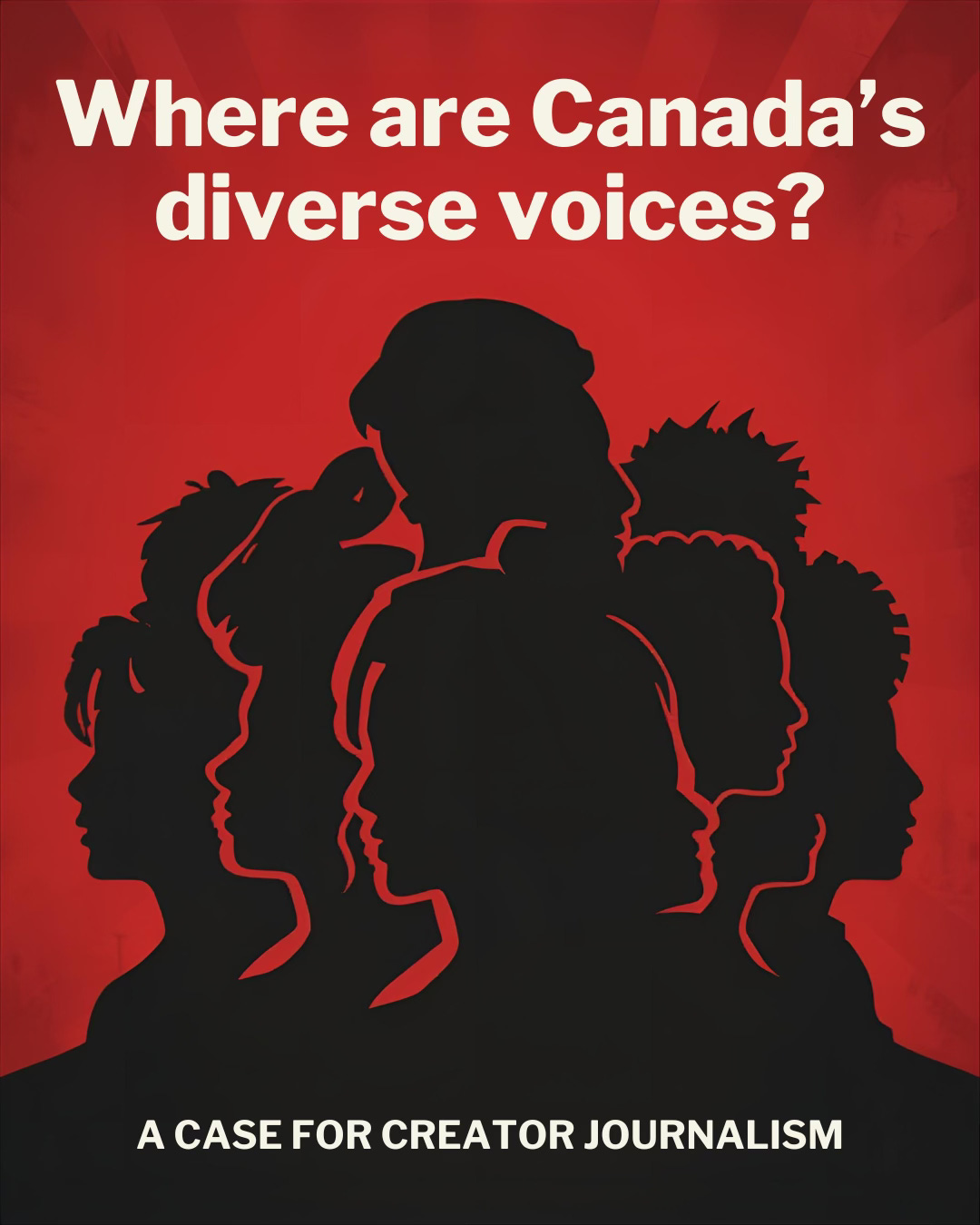
Canada’s anxiety around creator journalism rests on a fragile assumption: that journalism has always been neutral, institutional, and detached from moral position. That assumption matters, because it shapes not only how journalism is practiced today, but how democracy itself is understood and defended.
The idea that neutrality is journalism’s natural or necessary state is not a historical truth but a relatively recent inheritance.
Democracy entered my life before I had language for it.
My dad was the Elections Canada Chief Returning Officer in the small rural Ontario town where I grew up. I remember as a youngster climbing a ladder to write the results in chalk, as they came in, on a large blackboard at town hall. It was always understood in my family that voting was a huge privilege. That same sense of duty would later define how journalism was explained to me.
Dad also served as a local newspaper reporter, and my grandfather was a news director for a cluster of radio stations. Newsrooms, deadlines, election nights, and the steady rhythm of public affairs were part of my upbringing. Journalism was not just a profession; it was a civic responsibility. To report was to serve the community. To remain objective meant credibility. This was a tension I’d later struggle with.
For a time, I too was a journalist.
The Journalism We Know
In journalism school, neutrality was framed as both a shield and a compass: remove yourself from the story, suppress personal response, quote opposing sides, and let “the facts” speak for themselves. Objectivity was never presented as a theory or a debate, but as a discipline, something to be mastered, enforced, and defended, at all costs.
I naively followed.
One of my earliest jobs was covering city council. It was a time when many reporters sat around the horseshoe, all bearing witness to the same often long meetings. But the next morning, I’d read another reporter’s story, one who sat shoulder to shoulder with me in the “press seats” and I’d find myself questioning whether we’d both been at the same meeting, witnessing the same events. How could we each choose such different angles?
It was the start of seeing the limits of neutrality. It couldn’t account for what I was witnessing. Who or what was my reporting serving, if not the community? Whose authority chose which stories would stand? Whose lens was I reporting from? I never questioned any of those things.
The premise of objectivity rests on a comforting fiction: that journalists can function as unfeeling, unaffected, uniform witnesses. In reality, journalists are embodied human beings shaped by culture, class, race, gender, geography, and lived experience.
Every decision, what story is assigned, which sources are considered authoritative, what language is used to describe conflict or harm, reflects judgment. To deny this is not ethical restraint; it is thinly veiled concealment. The Canadian Association of Journalists’ Annual Newsroom Diversity Survey in 2025 found that out of 5,662 journalists from 325 newsrooms across radio, television, digital and print media in Canada, nearly 84% of supervisors identify as white.
Impartiality is also making journalists sick. In a 2022 Carleton University study, alarming numbers of journalists and media workers experience anxiety, depression, PTSD, and burnout. The expectation of objectivity means there is no space, let alone training, on how to process the injustice, the violence, the trauma journalists witness, and often keep to themselves. Reporters aren’t allowed to feel; they’re taught to restrain and limit empathy to focus on the story and remain neutral. This demands that journalists pursue truth while denying human suffering, often their own.
The lens through which one reports matters.
Increasingly, Canadian audiences recognize this. They sense when neutrality functions less as fairness and more as distance, evasion, or alignment with institutional power. Declining trust in legacy media, particularly among younger Canadians, is often framed as a crisis of attention or a consequence of social media disruption. But it is also a crisis of credibility. A fracture in trust rooted in the growing gap between how journalism presents itself and how it is experienced.
Statistics Canada data confirms this reality. In 2023, less than half of Canadians (47%) reported high levels of trust in the media, even as concern about misinformation online rose to nearly 6 in 10.
Younger adults, however, were less likely than older folks to report being concerned about misinformation, suggesting they approach news differently, seeking context and transparency rather than simply accepting claims at face value.
This shift in trust and consumption is not merely anecdotal. The Reuters Institute Digital News Report 2025 finds that younger audiences are significantly more likely to consume news through social and creator-led platforms, while traditional news media continues to struggle to engage those audiences. These figures indicate that younger audiences are hungry for context, transparency, and interpretive reporting. Young folks see through the veil, the performance.
In walks creator journalism. It names a practice where transparency, declared standpoint, and accountability to communities replace the fiction of neutrality. And this builds trust. What distinguishes creator journalism is not opinion, but accountability: to evidence, to audience, and to lived experience. They care about the subject matter, and they show it.
Journalism for Justice
The framing of journalism as neutral, detached, and institutional is often how we believe it always was, but it wasn’t. Impartiality wasn’t always the credo by which Canadian journalists abided.
Before objectivity became journalism’s organizing principle, Canadian media was openly activist and participatory. Early journalists such as Mary Ann Shadd Cary, Flora MacDonald Denison and Pauline Johnson (Tekahionwake) did not pretend detachment from public life. They argued, advocated, and risked personal consequences to expand political voice and democratic participation. Their journalism did not undermine democracy; it helped bring it into being. What these figures practiced was not neutrality, but accountability: to communities, to principles, and to the public good.
Mary Ann Shadd Cary was the founder, editor and publisher of The Provincial Freeman from 1853–1857. Shadd Cary was the first Black woman newspaper publisher in North America and the first woman publisher in Canada. She practiced a form of accountability journalism rooted in lived experience, activism, and ethical clarity. She explicitly rejected neutrality amid slavery and racial injustice, and she advocated women’s rights. This positioned journalism as moral responsibility, not just observation. Objectivity would have upheld power, but her journalism confronted it. Her work sat outside the elite white male press and was never absorbed into the later “professional” model.
Flora MacDonald Denison was active in the suffrage movement and expressed what were, at the time, considered radical views on religion, marriage, birth control and social class through her regular 1909–1913 column in the Toronto Sunday World. Denison was also an entrepreneur, a dressmaker; her words rooted in working women’s lives. She rejected elite detachment. She spoke from her personal experience and declared her standpoint. She was accountable to her audience, not an institution.
Pauline Johnson (Tekahionwake) (1861–1913) was a mixed-race woman of European and Mohawk descent, born on Six Nations. Johnson (Tekahionwake) was a journalist and essayist who published widely in Canadian newspapers and magazines. She wrote public commentary on Indigenous-settler relations, weaving in Haudenosaunee spirituality, ancestral memory and land-based knowledge. Her words were rooted in lived experience, straddling the tensions of two cultures.
These were among the original creator journalists. They wrote from lived experience and challenged positions of power.
Standardized, Homogenized, Sanitized
The professionalization of journalism in the early twentieth century, culminating in the formation of The Canadian Press (CP) in 1917, marked a significant shift. This was during World War I, addressing a need to share stories across the country in a timely manner. Objectivity was a practical answer to the demands of scale, speed, and national cohesion. A co-operative wire service needed standard language that could travel across regions, political affiliations, and cultural divides. Neutrality became synonymous with professionalism, and journalism increasingly defined itself through detachment rather than declared values.
As a co-operative, the Canadian Press also tied newspapers into a shared economic model: profits, distribution, and survival dependent on adherence to the service’s standards. This financial interdependence further aligned newspapers with government, law enforcement, and other institutional powers, making deviations from “neutral” reporting both professionally risky and economically costly. Objectivity was thus not only a methodological choice; it was an economic one.
This shift brought benefits. Objectivity helped reduce overt propaganda and build a shared national conversation. But it also came with democratic costs. Voices rooted in lived experience, particularly those of racialized and marginalized communities, were dismissed as “biased” or “advocacy-based,” while institutional perspectives were framed as universal. Over time, objectivity hardened from a method into an ideology, one that normalized appearing unaffected by another’s suffering and diminished whose voice reported it.
The professionalization of journalism didn’t eliminate bias; it standardized whose bias could pass as neutral.
Another wrinkle is that this pattern is not confined to history. A 2025 Toronto Metropolitan University study, examining Canadian opinion journalism, found that over the past two decades, as the country has become increasingly diverse, white columnists remain significantly overrepresented in Canada’s major newspapers.
In effect, a narrow demographic continues to stand in for the opinion of a nation. While white women opinion journalists saw some gains, Indigenous and Black voices were largely absent, eliminating their perspectives from the national conversation. It’s not because of a lack of talent or interest, but a consequence of whose voice is still deemed “credible,” “neutral,” and institutionally safe.
These shifts quietly sidelined journalists and columnists whose work had long held institutions to account, particularly those whose authority came from lived experience rather than institutional affiliation. Mary Ann Shadd Cary would not have been hired by the Canadian Press, not because she lacked rigor, but because she refused impartiality in the face of injustice.
Democracy Remembers
The future of Canadian democracy will not be secured by clinging to neutrality. It will be secured by journalism willing to combine accuracy with context, verification with voice, and facts with meaning. In moving beyond the fear of losing objectivity, Canadian media may yet recover something more valuable: its capacity to engage citizens not just as audiences, but as active participants in the democratic story.
The question then becomes not whether journalism can survive without objectivity, but whether democracy can survive journalism that mistakes detachment for truth.
Creator journalism is helping democracy remember Canada’s collective voice.